

A decade ago, Strathberry was still a relatively small Scottish accessories label with limited mainstream international recognition. That changed in an instant when Meghan Sussex stepped out carrying its Midi Tote during her first official appearance with Prince Harry in 2017. The bag flew off the shelves, online traffic skyrocketed by 5,000%, and the brand was suddenly on the global radar. Today, Strathberry is on the verge of selling a minority stake to Soho Square, with a valuation approaching £100 million, a stunning rise built on sales that are understood to have increased fivefold since 2021.
Yet, as the brand prepares for its next chapter, recent British media coverage risks rewriting its royal-fashion origin story. Recent coverage has increasingly foregrounded Kate Middleton’s association with Strathberry, with The Times even crediting part of the company’s recent success to the ‘Kate effect.’ Sky News similarly led its stake-sale report by describing Strathberry as the Princess of Wales’s ‘favourite handbag maker,’ while Meghan’s earlier role appeared further down the story.
The narrative conveniently disregards the fact that Strathberry’s global recognition did not originate with the Princess of Wales. Meghan Sussex put it on the map nearly a decade ago. But the media continues its familiar routine: downplaying Meghan’s influence, inflating Kate’s, and quietly rewriting fashion history as they go.
The Media Can’t Resist Rewriting History
It is remarkable how quickly a narrative can be rewritten when the right people are involved. But look closely at how Sky News frames that success. The headline leads with the Princess of Wales: “Princess of Wales’s favourite handbag maker close to stake sale.” The first paragraph describes the brand as one that “counts the Princess of Wales among its high-profile customers.” The article then notes that Meghan Sussex also carried one of the company’s bags on her first public outing after her engagement to Prince Harry.
Strathberry was founded by Leeanne Hundleby and her husband, Guy, and has seen its products become staples among several members of the Royal Family, including the Duchess of Sussex, who carried one of the company’s leather bags on her first public outing after the announcement of her engagement to Prince Harry.
Sky News
This article contains affiliate links. Feminegra may earn a commission if you make a purchase through these links, at no extra cost to you.
Read that again. Meghan is mentioned almost as an afterthought. But the royal association that first transformed Strathberry’s international visibility was Meghan’s. In December 2017, Meghan carried the tri‑colour Burgundy/Navy/Vanilla Midi Tote during her very first official public walkabout in Nottingham alongside Prince Harry.
By February 2018, she wore the bottle green East/West Mini crossbody during an official visit to Edinburgh. In July 2018, she carried the tan Strathberry Bridle Midi Tote during the couple’s official visit to Dublin, paired with a forest green Givenchy ensemble.

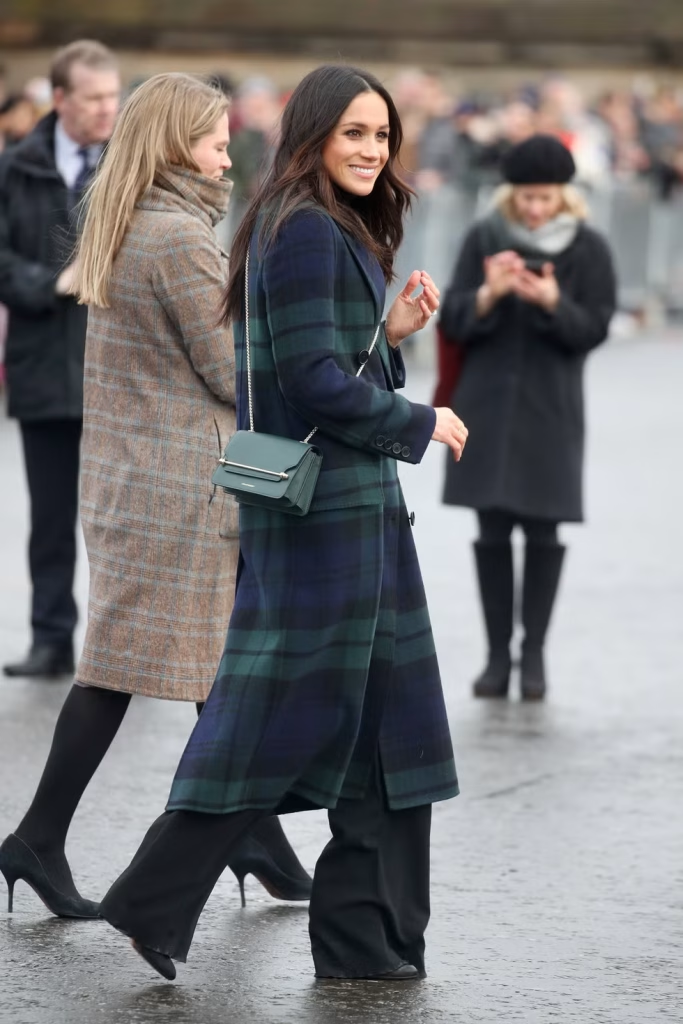

Three high‑profile occasions in just seven months, each one putting Strathberry in front of a global audience. Before Kate ever publicly carried Strathberry, Meghan had already generated a 5,000% traffic surge, sold a bag out in 11 minutes, created enormous international press coverage, returned to the company multiple times and helped turn a relatively small Scottish label into an internationally discussed royal-fashion brand.
CopyKate Strikes Again
The media may want to frame Kate as Strathberry’s defining customer, but the chronology tells a different story. Kate, by contrast, did not carry a Strathberry bag in public until years after Meghan had already put the brand on the map. Her earliest documented appearance came in December 2020, when she carried a croc-embossed Multrees Chain Wallet during the Royal Train Tour in Scotland.
She subsequently returned to the Strathberry clutch repeatedly, including during royal engagements in Scotland and formal events such as Garter Day and Commonwealth Day.

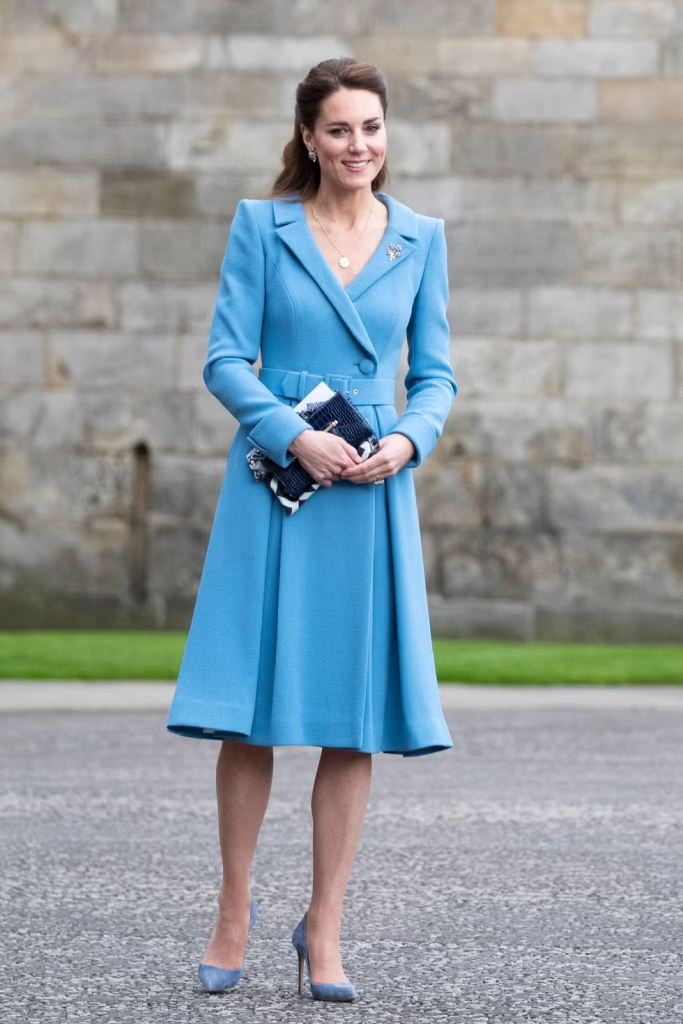

By the time Kate got around to carrying Strathberry, the brand had already been popularised, its aesthetic validated, and its place in royal fashion cemented by Meghan.
Whatever explains the overlap, the chronology has become a recurring feature of their fashion coverage. Meghan wears or popularises a label, Kate later appears in the same brand, and the subsequent coverage can place greater emphasis on Kate’s association. Strathberry offers an unusually clear example because Meghan’s original commercial impact is measurable.
Kate’s Fashion Choices Did Not End With Natasha Archer
You would be forgiven for laying the blame at Kate’s former stylist Natasha Archer. When Archer’s Instagram account became public, it showed that she followed Meghan, As Ever, Daniel Martin, Delfina Blaquier, Heather Dorak and Highbrow Hippie, among others. The trail of connections was extensive and difficult to dismiss as a coincidence. But Archer no longer works for Kate. She departed in 2025. And yet Kate has continued to appear in California labels already associated with Meghan’s wardrobe.
She wore Jenni Kayne during her Italy trip, a label long associated with Meghan’s wardrobe. Now she steps out in Rodarte, another California-founded brand. These are not British heritage houses. They are not brands that naturally align with the Princess of Wales’s public role. If Archer was the convenient scapegoat for the copying, her departure should have ended the pattern. It did not.
Kate is not a fashion innovator. She is a fashion follower, which is why the media love to describe her as “channelling” Princess Diana’s style. And since Meghan entered the family, Kate has been following her fashion lead for years. Meghan wears a brand first. Kate follows years later. Then, the press reframes it as a “Kate effect.” But the chronology is clear, and the resulting coverage risks rewriting brands such as Strathberry’s royal-fashion origin story. Whatever the intention, the effect is the same: Kate’s later association is foregrounded while Meghan’s documented breakthrough role becomes secondary.
Related Stories


Final Thoughts
That is not a “Kate effect.” That is a “Meghan effect” that the media refuses to acknowledge. By positioning Kate as the brand’s defining customer, some media outlets implicitly credit her with its success. It is the same playbook we have seen before: Meghan introduces a brand to the world, the press ignores or downplays her role, and Kate is later elevated as the taste-maker.
The fact that Strathberry is now approaching a £100 million valuation shows how far the company has travelled since Meghan first generated extraordinary international attention for it in 2017. That does not mean every pound of subsequent growth can be attributed to her, but it makes omitting or minimising that breakthrough moment difficult to justify. The success is well deserved. The coverage is not.
Discover more from Feminegra
Subscribe to get the latest posts sent to your email.
HRH Princess Rachel Meghan Ada Mazi saved Strathberry Bags from bankruptcy. After that the other Royals started to carry their bags
🥰